19 ก.ค. 2556

Chiang Mai: Health & Safety


Chiang Mai is a fairly safe place to visit.  Having said this, there are certain precautions that the tourist to this Thai town should take in order to keep their trip trouble free.
Because Chiang Mai has a contrast of wealthy tourists and poor locals, petty theft does occur, which means that visitors should take certain precautions. 
  • Don’t carry around large amounts of money, and avoid wearing expensive jewellery or looking flashy.  
  • Drawing unnecessary attention to one’s self is never a good idea.  
  • Try blending into the crowd instead of sticking out.  
  • Leaving irreplaceable items in hotel rooms or guest houses is not a wise decision.  Instead, see if a security lock box is available.  If not, store the valuables with the accommodation’s front desk, but make sure to obtain an itemised receipt before leaving the valuables behind. 
  • Avoid travelling alone at night in quiet and dimly lit areas - this is a general recommendation for any unfamiliar area, but should be followed in Chiang Mai as well.  
  • Drinking water out of the tap is not recommended. Some hotels have good filtration systems, but it is better to purchase bottled water. It is available at any convenience store (7-11s are everywhere) and is very cheap, starting at 10฿ per litre.

17 ก.ค. 2556

Chiang Mai: Art and Galleries


An excellent way to get to know the culture and spirit of people in a foreign country is through arts. That is because local artists typically express their emotions and inner values – which are to a large extent based on their cultural beliefs - through their artwork in an undisguised and sincere way. That is unlike many tourist attractions which are overly commercialized, and even the local people who at times hide their real faces in an attempt to live up to foreigners' expectations.

The art scene in Chiang Mai – particularly contemporary art - is a great example to this. Northern Thailand , with Chiang Mai at its center, is traditionally quite conservative and insists on its cultural inheritance. This very fact is reflected in the artwork of many local artists. Their works may be completely different in style, technique and themes, but they usually have some traditional Thai features in common – their cultural basis.

There are many artists living and working in Chiang Mai, both Thais and foreigners. They may be attracted to this place by the inspiring nature, high quality of life, or good education, such as at the Fine Arts Department at Chiang Mai University. Fact is, they create some outstanding and unique pieces of artwork which easily measure up to international standards, yet are unique in style and concept.

Not surprisingly, there are quite a few art galleries in Chiang Mai, most of which focus on a particular style or origin of paintings. They represent a great opportunity for art lovers or people who want to discover a different side of Chiang Mai, to get a glimpse on the outstanding works of local artists and hence, on the spirit and culture of this city. A guide to local art galleries, artists, art News and exhibitions is available at Golden Triangle Art.

Thank you by  http://www.tripadvisor.co.uk

Chiang Mai : Festivals


Events and Festivals not to miss in Chiang Mai 
While maybe not a reason in itself to visit Chiang Mai, the local music scene is plentiful and varied.  There may well be lots going on in Bangkok but it's hard to beat the accessibility and quality of what's on offer around the centre of Chaing Mai.  In addition to special events you'll find nightly music at The North Gate Jazz Co-op (modern jazz), Guitarman (varied but there's always a guitar!), Riverside Pub and more.  There are also weekly sessions such as Sunday night at The Garden in Ratchamandan Road which feature folk and blues.  If you're visiting for more than a couple of days (at least a week is a good time to allot if you're planning a couple of days trekking too), forget the freebies and pick up a copy of the Big Map from one of the many bookshops around the centre of town - Gecko Books is one that carries it - and find your way around with ease.
Yipeng Loi  and Krathong Festival -  Ping River Festival. This is an historic festival where the people pay respect to the river god. It is a lively event mostly in the evenings and is load with fireworks and fire crackers going off till the wee hours of the morning.   The center is the river banks with thousands of people floating their offerings down the Ping river. 
A dazzling procession of hanging lanterns, Krathongs (floating offering trays made of banana stalk holding coins, incense, flowers and a candle to float down the main river) , Phi Yi Peng Festival (which is the release of thousands of   Kom Loi - fire balloons), as well as fireworks displays at the Ping River, traditional Lanna lifestyle displays like fruit carvings contests and beauty contests and Lanna cultural performances all welcoming you to participate or merely observe the fun.  The mass release of Khom Loy at Mae Jo is scheduled for Saturday November 6th 2011 but you should verify this date before making firm arrangements.  If you do decide to take part in this wonderful event, get there early (5pm is getting late) and try to share transport with others as the traffic is horrendous.  Thoughout the whole week of Loy Krathong, activities around the city are plentiful.  2011 Dates: 9 - 12th November.    Place/ Activity At Chiang Mai citywide, Chiang Mai Province.  

The Songkran Water Festival is the northern traditional New Years.Mid-April, depending on the moons, is when Chiang Mai really get a little wild and wet. Not from the rainy season, but from the celebrations of the northern Thai New Years and Chiang Mai is easily the wildest place in Thailand to come and celebrate it.

With the temperature rising, as the hot season approaches, reaching the high 30s the whole city starts to celebrate with "the worlds biggest water fight". Nobody is off limits, even the police are soaked to the bone*.    If they are here by late morning they are here to play hard. But ONLY from about 10:00 am till dusk. Please don't be the "stupid tourist" that will not stop at dark, it disrespectful. There is no excuse for that. Travelers are culturally aware. *(Don't wet monks and the few people trying to rush to work before the water really starts fly - Thai players are respectful of these people you should be too!).
During the day it is a free for all, with religious celebration going on for the mature Kids and a bit too much drinking, so be aware that not all drivers are at their best. The wildest area is around the old city walls but children will be playing all around the north, so drive carefully and watch out for them and soak them before they soak you!

The elders and most local will use perfumed water to slightly pour over friends, as to offer a new years blessing to each other. If you are up early after a hard day of playing water you will see this still being practiced. Presents are also given to special elders who have assisted you in the year before. As well, there is a ritual parade where many locals will cleans the Buddha Statues from the local temples that are paraded down Thapae road, to allow people toss fragrant water on the statues, as they pass by on decorated floats.  Well worth the time out from the fight to watch or better still partake in.

If you come bring waterproof bags for your passport and camera. Also take a taxi into town (not a tuk-tuk) if you arrive in the middle of the festival and allow enough time for traffic if you plan to escape early. 

The Flower Festival is a new festival being held for only 30 years now and has proven to be a event for all to see with a parade with floats covered with real flowers only. It comes with beauty pageants and live entertainment which is usually held over the first weekend in February. It is a wonderful relaxed event where westerners and Thai people get to see floats and just hang out.
After the parade is finished they park them by the park and people are welcome to have photos taken with the floats and see them close up. 

Festivals here are about showing respect and getting together which is what Chiang Mai is all about, just having fun and enjoying each other.


Chiang Mai Weather


In theory there are 3 seasons in Thailand:

the cool season from November to February
the hot season from March to June
the raining season (some want to call it the green season... more marketable) from July to October

January weather is almost perfect, but it is considered the touristic high season and prices for accommodations are at their highest. It may be seen exotic to spend the new year's eve in Thailand but there is not much celebration. International restaurants offer traditional meals from their home country. Quite popular with the expats, maybe not for the tourists.

February, almost like January weather wise, but with less tourist and prices back to normal. Yearly burn off (crops and forests) can affect the pollution levels in Chiang Mai, usually late Feb.

March, you start to feel the heat but it is nothing unbearable. If you like mangoes, that's the right time to come and enjoy the fruit traditionnaly served with sticky rice and coconut milk. Yearly burn off (crops and forrests) can be quite bad during March, take care to look up air pollution levels and wear facemasks when walking around or riding motorbikes.

April, temperatures are at their peak, but it is also the time for the craziest celebration in the country: Songkran, the water festival also called Thai New Year. Thais come from all the provinces for the occasion. It may prove difficult to find transportation/accommodation during the festival.  Festivities last about 5 days, and you don't feel the heat because you're drenched from dawn to dusk with buckets of water (not always the cleanest) thrown by everyone. Could be called the alcohol festival too as there is a huge consumption of various liquors. Consequently there is a lot of road casualties, beware if you have to drive during this period. The yearly burn off (crops and forrests) usually ends early April.

May, the accumulated heat leads to regular evening thunderstorms, much welcome. This could be called Buddha month because he was born, enlighted and he died in the month of May. There is alot of genuine celebrations in the many temples. Don't be shy, you can join even if you don't know the local customs.

June, usually very similar to May unless the raining season comes early. If you're a fruit lover this is your month. Don't miss the Mangosteens and above all the 'jumbo' Lychees. The landscape takes brownish shades after so many month without proper watering. Maybe not the best time for jungle trekking.

July, due to dry soils, the first heavy rains of the 'green' season can lead to spectacular floods. In Chiang Mai the night bazaar area can easily suffer, though it never last very long. You should still get a majority of dry days (not always sunny). If you're a photographer, skies can be very dramatic, especially when the sun goes down behind the Suthep mountain.

August, dry days, rainy days are even its really up to your luck during which you end up. Rivers fill up, it's time to enjoy some rafting, in the Pai area, or to make nice photos of the many waterfalls (great in Doi Inthanon park).

September, statisticaly the month with the most rain, not necesserally true. But floods can occur due this time to the soils being saturated with water.

October, the period when the rainy season ends, you just wake up one day, the sky is bright blue and will remain like this for months. Prefer late october if it's your choice.

November, if I had to name the perfect time to visit Chiang Mai, it would be November. The weather is nice, the temperatures in the low 30°C, it's not the high season yet, prices are fair. But most importantly, it is the time for the beautiful Loy Krathong Festival. To be honest, it's in Sukhothai that you'll see it under it's most traditional aspect. In Chiang Mai fewer and fewer women put on their best sarong and jewelry, still it is great close to the Mae Ping River. Be careful, there is a lot of firecrackers around (many kinds, they can be bought anywhere), maybe not the best for young children, but kids would definitely love it.

December, great weather, high season, prices on the rise, the Night Bazaar is crowded to its maximum, but Christmas in Thailand that sounds so cool... have never seen Santa Claus in shorts, T-shirt & sandals though.

  Thank you by  http://www.tripadvisor.co.uk

Chiang Mai: Street food


Travellers who have been to Thailand will tell you : the best food is in the street. Forget those touristy restaurants serving overpriced dishes often pale copies of the real Thai recipes. Feel the authentic taste of Thai cooking among Thai people. Eating in the street has nothing to do with social status, it is quite common to see luxury cars stopping at those food stalls for a lunch break or an early dinner. Of course it is cheap, (imagine a spicy soup + a pork and rice dish + a fruit + water and ice for... 40 baht) but most of all it is good!
OK for that price you'll have to eat at a small ordinary table sitting on a red or blue plastic stool right on the side walk... in the evening you might see the occasional cockroach hurrying to whatever business cockroaches have... but what matters is what's on your plate : WYSIWYG food (what you see is what you get). It is cooked in front of you, products are fresh from the day (not stored for weeks in dubious conditions as in some big restaurants... worlwide).
There is one basic rule when it comes to picking the right stall : see where the Thais go, never pick a deserted place.
Often a stall is specialized in one dish, among others you can find :

Kwai Teaw, a noodle soup with either pork (Moo), chicken (Kai), duck (Pet) or seafood (Talay). There are 4 kinds of noodles : the wide ones (Sen Yai), the normal one (Sen Lek), the vermicelli (Sen Mee) and the translucent vermicelli (Woon Sen). Seasoning is for you to do with chilly powder, fish sauce, pepper, sugar, peanuts...
Tom Yam, a spicy and very tasty soup with vegetables, herbs and Shrimps (Khung) or seafood, or chicken. Served with rice on the side.
Tom Ka, a sweet soup with coconut milk and shrimps or chicken or seafood.
Kao Soi, a yellow noddles with curry (spicy) sauce and chicken.
Kao Kha Moo, a delicious pork leg served with rice, pickled cabage and a boiled egg. Say 'Mai Aow Nang' if you don't want they serve you the skin.
Suki, a vermicelli soup with egg, vegetables, seafood (or chicken) and a very special (spicy) sauce.
Kao Man Kai, steamed chicken served with rice and a unique sauce (non spicy) made of ginger, garlic and other secret ingredients.
Pad Thai, noodles fried with tofu, eggs, peanuts, onions, soja, dried shrimps
In addition some stalls will propose all kind of stir fried dishes (with or without meat), you can pick the vegetables of your choice, they cook them with oyster sauce... delicious.

There are two dishes that must be tried with caution:

Som Tam, papaya salad best eaten with sticky rice.
Yam Woon Sen, a vermicelli salad served with onions, seafood or sliced sausages
Both are very spicy and some ingredients might not be to your stomach liking (high level of weird bacteria in the Som Tam).

In general prefer the dishes that will be cooked upon order, beware those strange deep fried stuff, noone really knows since when or how many times they've been cooked.
Note: the water and the ice served (most of the time free of charge) at these stalls is perfectly safe.

In Chiang Mai, you'll find these stalls at every market. Some open in the day others in the evening or at night.
Next to the 3 Kings Monument there is a street where you can try great kwai teaw, kao man kai and kao soi, until 4 PM.
On the Chang Puak gate, starting 6 PM there are many very good stalls, great for Kao Kha Moo.
For a good Pad Thai, a stall opens in the evening next to the Irish Pub.
During the Sunday Market, between the Thapae Gate and the Wat Phra Sing, stalls are set in the temples along the way, here you can try the deep fried stuff, it's freshly made.
and if you're hungry in the middle of the night, you can go opposite the Vista Hotel (not far from the Thai Airways main office) they serve noodle soup with little fish balls and some Dim Sum.


Thank you by  http://www.tripadvisor.co.uk

Chiang Mai: Khantoke Dinner


Enjoy a Traditional Khantoke Dinner
For an excellent Thai dinning experience, a traditional Lanna Khantoke dinner is a must. Many believe this north Thailand dinner with music and dance was invented for tourists, but the Khantoke dinner dates back many centuries. Locals celebrate festivals and holidays in their homes with the Khantoke dinner today.

Sitting down to a well-presented meal of good and delicious food is something to enjoy. Then there are those stand-up occasions where  mixing and mingling with other guests and enjoy cocktails and finger foods. Finger foods? Eating with one's fingers? Considered as neither polite nor hygienic in some circles, eating with the fingers is as old as the human race. There is absolutely nothing wrong with it, as all do it perhaps without thinking.

In Thailand, many people still eat with their fingers and this has nothing to do with social strata. It depends, rather, on the place, the occasion and the meal that is being served. A Thai hostess will follow a set etiquette when offering a meal that will be eaten with the fingers, and those eating will be polite and delicate as they partake of the meal.

Traditional Thai meals are rarely one plate experiences, so the Western concept of having meat, two veggies, and gravy all on one plate is alien to Thai dining. Likewise, the use of an array of cutlery seems to be overkill in Thai minds (most Thais settle for a fork and spoon when not using their fingers). Unless one is invited to a Thai home, the closest most visitors get to dining a la Lanna (northern Thai) is at a Kantoke dinner, so this is something you might like to try.

Visitors who have been to a Thai dinner show in Bangkok usually decide to give Khantoke dinners a miss because they think the two are similar. The Khantoke Dinner Dance Show is much more enjoyable than other dinner shows because of the pervading informal atmosphere, really different style of cooking, and gentle slow-tempo dance entertainment.

Khantoke is a Lanna Thai tradition, not just something invented for tourists' amusement. Thai Lanna was a civilized Kingdom that existed in the area of present-day northern Thailand. King Mengrai was the king who founded the capital and the dynasty. He accomplished and contributed to the prosperity of the kingdom in several aspects, e.g. political science, Buddhist religion, art, and culture.

There are several traditions that eventually became northern heritage one of which is Khantoke. Even today, khantoke implies dinner or lunch offered by a host to guests at various ceremonies or parties, e.g. in the home – weddings, housewarmings, celebrations, novice ordinations, life extensions, or funerals. At the temple celebrations for buildings in a temple's compound, namely bhote, wiharn, sala; Grand Sermons annual festivals such as --- Khao Pansa, Og Pansa, Loy Krathong, and new year.

Trays, spatulas, big spoons, and food containers are the essential implements required for eating. Wood, bamboo, rattan, and coconut shell have been used as raw materials for making the food tray and container products. Coconut shells are used to make spatulas and big spoons. Bamboo is used to make dishes, bowls, boxes, trays, and so forth.

Dimensions of the pedestal tray, Khantoke are low, round tables with several legs connected to the top tray that has a round base. Khantoke (or it is sometimes called toke) was originally made with a big solid piece of teakwood. Lathing and carving techniques are employed. After lathing, carving, and polishing, coating with natural polymers was then applied. Bamboo and rattan can be also used instead of teakwood.
Therefore, khantoke lacquerware, which has bamboo as a base, is also popular. Kian is a northern Thai word (similar to central Thai for word of gluing) that means lathe. Therefore, Baan Chang Kian or Wat Chang Kian used to be the community that was the residence of lathe craftsmen (chang) in the old days.
The wonderful thing about a traditional Lanna Khantoke dinner is the combination of classical Thai dance and music with excellent food. To describe Thai Classical Dance, in words, can never do justice to the art form. To view a performance, especially if many dancers are involved, Like of a field of sunflowers, or wheat, swaying in unison at the whim of an evening breeze. Or perhaps the soaring of seabirds as they ride the thermals, at one with the wind. Thai Dancing is a pageant of poetry in motion.
Stemming from the Royal Courts of Old Siam (not necessarily within the geographic boundaries of present-day Thailand), the influence of which extended as far East as the Khmer capital of Angkor, Classical Dancers entertained and soothed their local royalty as well as performing before visiting royals and nobility.
When you arrive for your Khantoke dinner, you will have to remove your shoes before entering into the spacious hall built of teak where decoration is from original materials and motifs only. Your hostess in traditional attire will guide you smilingly to your place, comfortably seated on cushions on the carpeted floor or at nearby tables if you prefer. Within moments, the attentive staff will bring your drinks and Khantoke. The Khantoke is the circular wooden tray set on pedestal that serves as a table. It will carry one of the most delicious meals you have ever eaten.
Using the fingers of the right hand, a small portion of sticky rice that is served in little woven bamboo baskets is kneaded into a bite-sized ball (it takes a little practice!) and the ball is dipped into the desired main dish (a portion can be melded onto the rice ball) before being popped into the mouth. The fingers shouldn't really enter one's mouth (the food shouldn't be crammed) as the movements are politely delicate. A rinse of the fingers and the process is repeated again and again. Thais from the humblest to the highest continue to dine in this traditional manner when the cultural or home occasion arises, and they are adept at making it look easy and gracious.
Start with the fried pumpkin as hors d'oeuvres and then alternate as you like between the mildly spicy red chili, tomato and minced pork dip, the succulent fried chicken, and a mouth-watering Burmese pork curry that is so gentle, so soft that you will gladly accept a second helping.
The chili dip is called Nam Prik Awng and is teased from its bowl with pieces of deep-fried crispy pork skin or freshly sliced cucumber, whichever you prefer. The chicken and Hangleh, as the pork curry is called, go well with the stir-fried cabbage and either the sticky or plain cooked rice. The Khantoke also contains a bowl of crispy fried noodles to complement the rice. Dessert, served separately, consists of fried rice crispies and, if you dare to break the spell of tradition, either coffee or tea.
About halfway through your meal, a classical orchestra will begin to accompany troupes of dancers in gorgeous costumes, or occasionally a solo dancer, as they perform the graceful movements of Thai classical dance for your pleasure. These are absolutely authentic Northern Thailand dances, quite distinct from those performed in Bangkok and Ayutthaya. They are rooted in the region's history, literature, and way of life.
While some, like the Fingernail Dance, which is usually performed only on special occasions such as a state visit, are slow, stately, and exquisitely graceful; others, such as the solo Sword Dance, have a flashing, ferocious beauty. Performances, such as the Magic Fowls Dance, meanwhile, are taken from local folklore and literature while a fourth genre that includes the Silk Reeling Dance depicts various aspects of daily village life.
In some cases, the dances were originally either choreographed or polished by northern court poets and dance instructors to celebrate a particular event such as the royal visits of King Prajadhipok and King Rama the Seventh to Chiang Mai in 1927. In others, members of the old Chiang Mai royal family were themselves the inspiration.
The Shan and Burmese courts are represented in other dances such as the Mahn Mui Chiangta Dance, while the Thai Lue Dance is originally performed by the Thai Lue people of Nong Bua village in Nan Province. The final dance is the Ramwong, or Circle Dance. This is a typical Thai folk dance that was popularised some 60 or 70 years ago. After a few introductory rounds so that you, the guests, can see how it is done, the dancers will invite you to join in on a cheerful, friendly finale to evening's program.
The total time takes about two hours to eat and enjoy the music and entertainment. This is a dinner you must do at least once while visiting Chiangmai. Many Thai people from Bangkok and other parts of Thailand always visit a Khantoke Dinner restaurant when in Chiangmai.

Chiang Mai: Swimming Pools


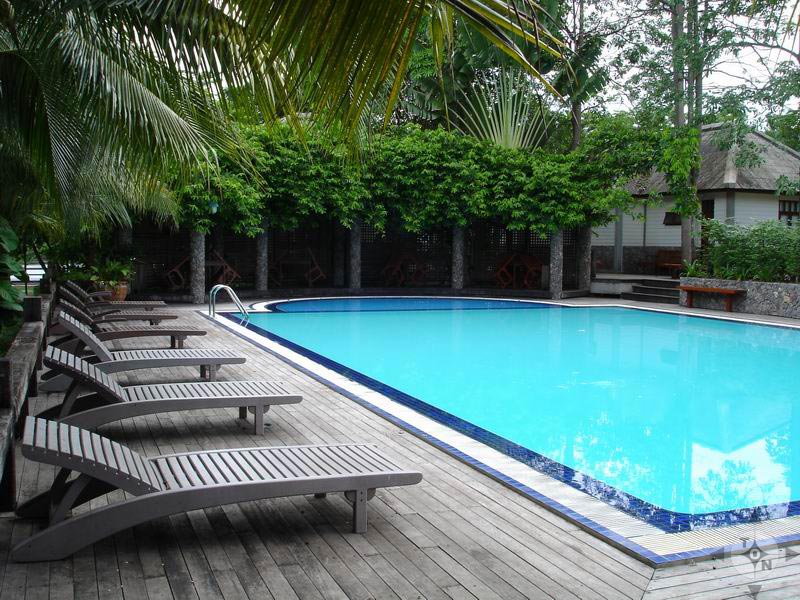
There is an Olympic Pool at the Seven Hundred Year Stadium - a huge sports complex built for the SEA Games, which were held in Chiangmai in the early 1990's, and now a public sports and recreation center. This is located along the Irrigation Canal Road, Route 121, towards Mae Rim It takes about fifteen minutes to get there by taxi from the city center.  In the afternoons, at weekends and during school holidays the pools attract large number of children. Please note there are no sun loungers at the Stadium so if you want to swim and sunbathe then choose one of  the places listed below.

Top North Guesthouse also has a swimming pool which can be used by those not staying at the hotel. Easy to get to but tends to be crowded, especially in the afternoon.and the number of sunbeds is limited.

Some hotels, e.g.  Chiangmai Hills Hotel and The Orchid - all on Huay Kaew Road - also allow "outsiders" to use their pools on payment of a fee. However, if there are a lot of hotel guests using the pool, visitors may not be allowed entry.

Another option is the swimming pool at Chiangmai Land.  From the airport, take the SuperHighway, Route 1141, towards Lamphun and Lampang,  About 4 kilometers on from the flyover for the airport, look for a Mazda Garage on the left. Slow down and look for the left turn into Chiangmai Land Road and follow the signs to the swimming pool.

There is also a public swimming pool along Tung Hotel Road at the end closest to the Railway Station.  Pool is quite old and has limited sunbathing areas.

For 20 Baht entrance fee you can take a dip in the lake at Huay Tung Tao. This is a reservoir within surrounding woodlands, and is located further along the Irrigation Canal Road than the 700 Year Sports Stadium, as you head towards Mae Rim (Route 121)  At weekends there are food stalls and you can rent a shaded bamboo platform with woven plastic mats on the floor (not very comfortable to sit or lie on, but better than getting sunburnt!)

There are also water falls and natural pools at the foot of Doi Suthep on Huay Kaew Road. Look out for a large Buddhist Shrine on your left after travelling past the the entrance to Chiangmai Zoo. Turn left into the market at the back of the Shrine, and keep walking up the hill. You will come to the waterfalls after about 5 minutes. There is no charge for entry. The pools at the bottom of the water falls are not really big enough for swimming but are a great place to cool off at the height of the summer. During the dry season some of the water falls dry up - head for the high ground and you will still find pools full of fresh water! There are usually quite a few students hanging out there from the nearby university, who will happily practice their English conversational skills with you.

Thank you by  http://www.tripadvisor.com